Hazardous Area Assessments
Hazardous Area Assessments
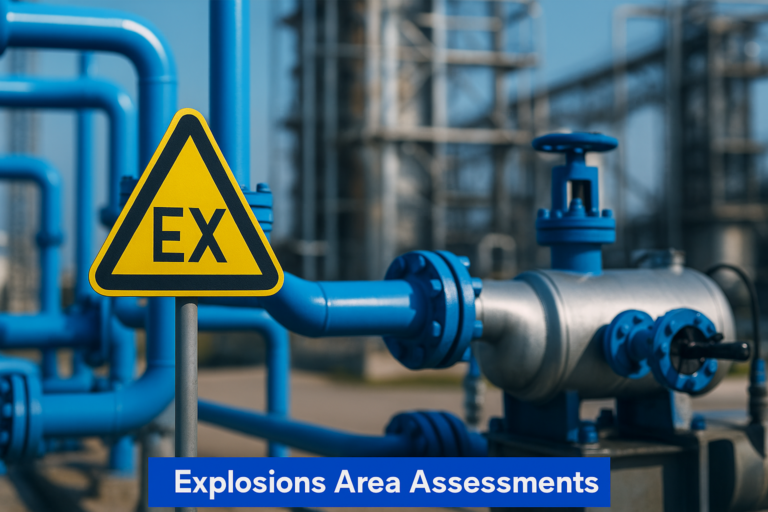
Our Hazardous Area Classification and Risk Assessment services provide a complete, engineering-backed evaluation of your facility's potential exposure to explosive atmospheres. These atmospheres may be created by the presence of flammable gases, vapours, combustible dusts, or fibres. We use internationally recognized classification systems-including both the Zone system (Zones 0, 1, 2 and Zones 20, 21, 22) and the Class/Division system (Class I, II, III; Division 1 or 2)-to ensure your facility's compliance with Code requirements. Our process includes site inspections, process mapping, and hazard identification to accurately determine the extent and boundaries of each hazardous location. We then produce comprehensive classification diagrams and detailed written reports.
Hazardous Area Classification & Risk Assessment
We identify and map explosive atmospheres-flammable gases, vapours, combustible dusts or fibres-using either the Zone system (0/1/2 & 20/21/22) or the Class/Division system. We produce comprehensive classification diagrams and reports signed and sealed for permitting and regulatory requirements.
Reducing Hazardous Area Classification Ratings
Before committing to costly upgrades or specifying specialized hazardous-area-rated equipment, our engineers work with you to explore engineering controls, administrative controls, and design modifications that can reduce the overall hazardous rating of a space. For example:
- ▶ Housekeeping Practices – Proper dust removal procedures in a grain handling facility can shift an area from Zone 21 (continuous hazard) to Zone 22 (occasional hazard), dramatically reducing equipment costs.
- ▶ Ventilation and Exhaust Systems – Installing targeted exhaust hoods near volatile process areas can prevent the accumulation of flammable vapours, lowering the hazard classification.
- ▶ Redundancy in Systems – Designing backup containment or purge systems ensures continuous safety even during equipment failure, reducing the need for expensive explosion-proof devices in some zones.
This approach often results in lower capital expenditures, faster procurement timelines, and greater operational flexibility while maintaining or exceeding safety requirements.
Equipment Selection Guidance
When reducing a hazardous area classification is not feasible, our role shifts to ensuring you select the right equipment for the environment. We provide specifications and recommendations for:
- ▶ Explosion-proof enclosures for electrical apparatus in flammable gas zones.
- ▶ Intrinsically safe (IS) circuits for instrumentation in high-risk areas, designed to prevent ignition under any fault condition.
- ▶ Non-incendive enclosures for equipment in Division 2 or Zone 2 areas, where explosive atmospheres are infrequent.
We also ensure the correct temperature ratings (e.g., T3, T4, T6) and group classifications (e.g., IIC for hydrogen, IIIC for conductive dust) are matched to your process environment. Our team specifies enclosure materials, conduit types, sealing fittings, and cable ratings to meet both CSA C22.1 (Canadian Electrical Code) and any applicable international standards. For facilities in classified locations, our Power & Distribution Systems design ensures all switchgear, feeders, and motor controls are appropriately rated and positioned relative to classified zone boundaries.
Post-Classification Review & Maintenance Planning
Hazardous locations are not static-process changes, new equipment installations, or shifts in raw materials can alter classification boundaries. Our Post-Classification Review services ensure ongoing compliance and safety as your operations evolve. We can:
- ▶ Reassess hazardous zoning after facility expansions or layout changes.
- ▶ Update classification diagrams when processes, chemicals, or dust-producing equipment are introduced.
- ▶ Develop preventive maintenance plans to ensure ventilation systems, dust control measures, and explosion-proof seals remain in top condition.
Why Partner With Us?
Our hazardous area expertise combines real-world industrial experience with deep knowledge of electrical code compliance and process safety engineering. We've conducted classifications in environments ranging from gasoline and fuel-dispensing stations, woodworking shops, paint booths, and more.
Whether your goal is cost reduction, safety optimization, or seamless permitting, our systematic, evidence-based approach delivers clear, compliant, and cost-effective solutions. Contact us today to discuss your hazardous area assessment.